
A week’s worth of previews from PETER WATTS IS AN ANGRY SENTIENT TUMOR
In celebration for the release of the irreverent, self-depreciating, profane, and funny PETER WATTS IS AN ANGRY SENTIENT TUMOR, Tachyon presents glimpses from the essay collection.
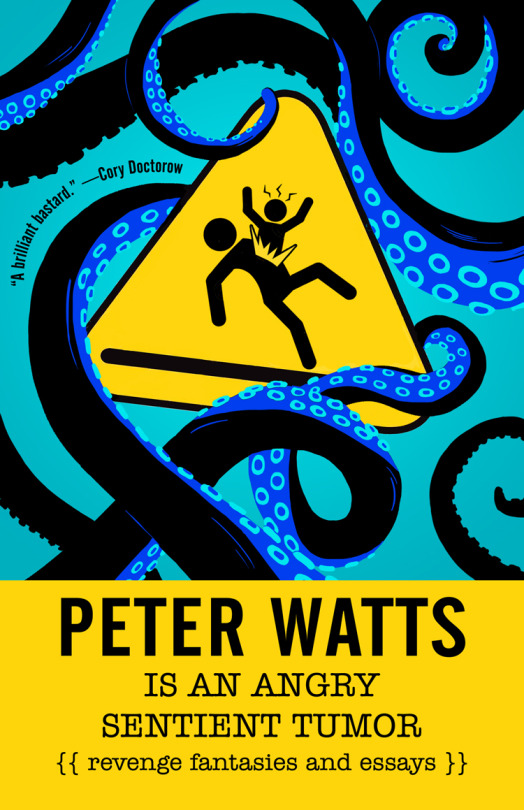
This week’s previews:
- Everything I Needed to Know About Christmas I Learned From My Grandma
- The Least Unlucky Bastard
- No Brainer

For more info about PETER WATTS IS AN ANGRY SENTIENT TUMOR, visit the Tachyon page.
Cover design by Elizabeth Story
Icons by John Coulthart
Nick Mamatas’ THE PEOPLE’S REPUBLIC OF EVERYTHING is a literary tour de force, that successfully juggles a multitude of genres, styles, and themes
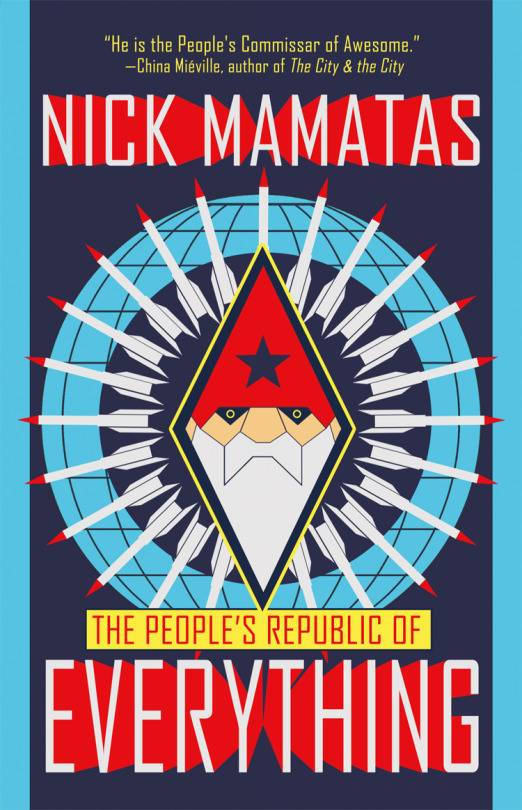
At FANBASE PRESS, Nicholas Diak praises Nick Mamatas’ THE PEOPLE’S REPUBLIC OF EVERYTHING.
Though not being genre-focused like other authors’ short story collections, Mamatas’ THE PEOPLE’S REPUBLIC OF EVERYTHING
is a literary tour de force, juggling a multitude of genres, styles,
themes, and experimentation with form. There’s political discourse
within the pages, but made palpable with Mamatas’ distinctive, engaging
style.
On Margaret Killjoy’s podcast WE WILL REMEMBER FREEDOM, Ben Church reads “The Great Armored Train” by Nick Mamatas.
SO, THIS IS WHAT COMMUNISM MEANS? Gribov
thought. The train was magnificent. It seemed too heavy to move, but it
fairly glided along the tracks. It was the smoothest ride Gribov had
ever been on, and it bustled with activity—warehouse, restaurant,
barracks, even a Politburo office and telegraph station, a two-car
garage, and even a small biplane among its twelve wagons. Never mind the
armored engines with gun turrets. All this, and it doesn’t even have a name! It was just the train of the Predrevoyensoviet, Leon Trotsky. Didn’t the War Commissar have a wife or a girlfriend to name his personal armored war-train after?But really, it was the workers’ train, and there was much work to be
done. Gribov was a soldier, but no longer just a standard peasant with a
rifle and a children’s book on the Russian alphabet to help him learn
to read. He was one of the Red Sotnia, the hundred soldiers who made up
Trotsky’s bodyguard and rushed out to join pitched battles. Not long
before, he’d been in the cavalry train that followed behind Trotsky’s,
shoveling horse shit. But the train, and the Bolshevik efforts, had
taken some hits lately, and now Gribov was decked out in black leather,
presumably ready to give his life for the world proletariat, and for
comrade Trotsky. Gribov dutifully collected the train’s newspaper, V puti,
but mostly used it to insulate his boots. It was cold tonight on the
Polish border, and he was glad that Trotsky wrote so much. Almost toasty , he thought, as he leapt from the roof of one car to another, watching the forest for Mensheviks, for Cossacks, for Poles.“Comrade!” one of the sharpshooters stationed on the roof whispered harshly. “Step lightly! You’ll bring them down upon us.”
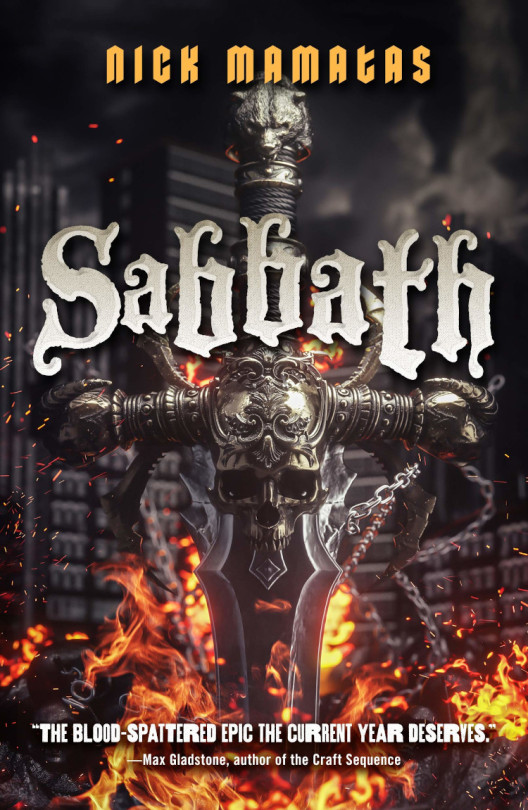
Michael Thomas Berry for NEW YORK JOURNAL OF BOOKS recommends Mamtas’ new novel Sabbath.
Overall, Sabbath is an entertainingly vivid, blood-soaked,
sexually charged page turner that is freshly conceived and surprisingly
poignant in its ultimate revelations. Mamatas does an excellent job of
weaving thought provoking and humorously snappy dialogue into the story.
His excitement in telling this type of tale (a subject he knows very
well) is unmistakable and profound. A highly recommended read for anyone
with a keen interest in violently graphic horror/ fantasy novels.
For more info on THE PEOPLE’S REPUBLIC OF EVERYTHING, visit the Tachyon page.
Cover by Elizabeth Story
Lavie Tidhar’s THE VIOLENT CENTURY is one of those rare books that stay with you long after finishing the last page
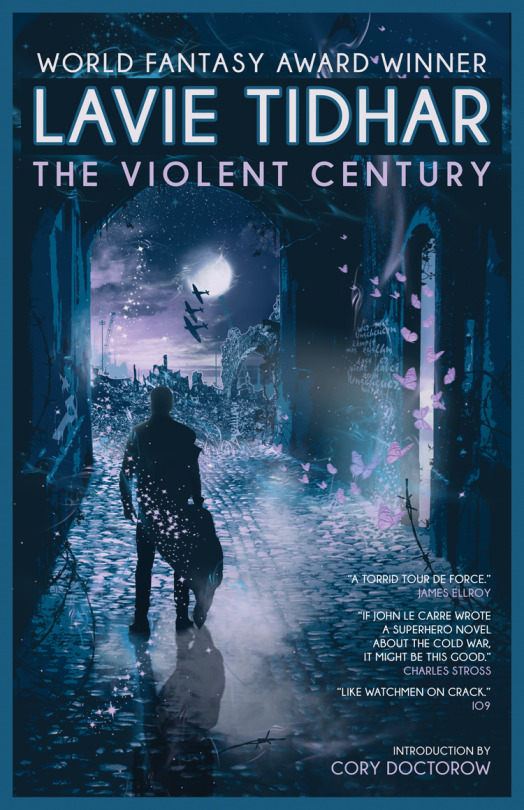
Robert Goodman at THE NEWTON REVIEW OF BOOKS praises Lavie Tidhar’s THE VIOLENT CENTURY.
Which all makes this book sound fairly serious. And given that it
catalogues world conflicts from the mid 20th-century onwards, with a
particular focus on World War II, it can be. But it also has heart, a
sly sense of humour, great action set-pieces and a range of fascinating
supporting players. Tidhar’s particular brand of science fiction and
alternate history has come to more prominence recently with awards for CENTRAL STATION and UNHOLY LAND, but he is an author who has been garnering praise throughout his career and THE VIOLENT CENTURY demonstrates why it is worth revisiting his back catalogue.
For FANTASY BOOK CRITIC, Łukasz Przywóski felt much the same way.
THE VIOLENT CENTURY is both demanding and rewarding. It won’t appeal to
everyone and I understand why some readers will put it aside because of
time jumps and fractured writing style. I’ve almost done it myself;
luckily I’ve persevered. If you give it a chance, you may discover it’s
one of the rare books that stay with the reader long after they finish
the last page.
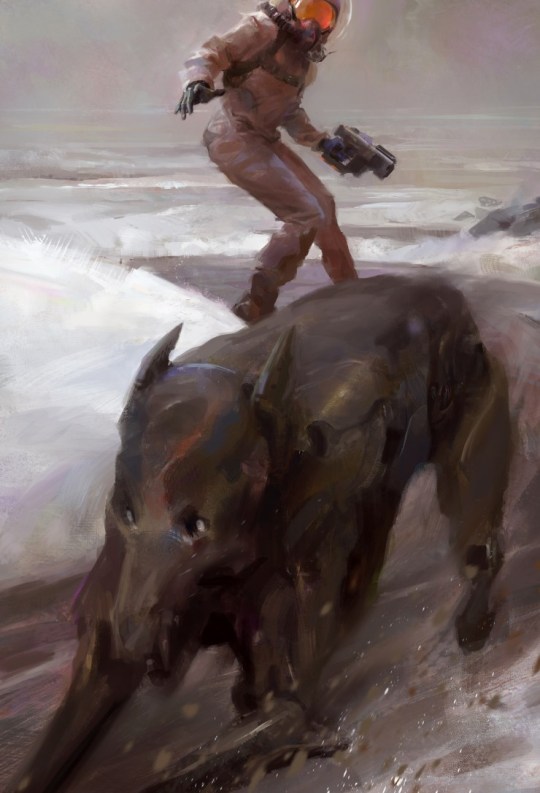
Illustration by John Anthony Di Giovanni
TOR.COM publishes the Tidhar short story “In Xanadu.”
The Theremin played.
In the great hall of the Banu Qattmir all was peaceful. The great
screen displays overhead flickered in a bright rainbow light of nothing
very much. The Keepers of the Cores went about their business on the
gleaming floor, seeming as small as ants in the vastness, and the music
played on. It had always been so, for as long as Nila could remember it.I hate it, she thought savagely. I hate it, hate it, hate it!
The hall was immense and the lighting always soft and the music
played on. Information scrolled up on the screens. The patrols went out
and the perimeter was secure. Nothing living or digital could approach
within a hundred klicks without being detected and if need be
eliminated. Overhead, the cloud of routers and signal repeaters extended
into the atmosphere of Titan and connected to the dark satellites in
the moon’s orbit. Old-fashioned underground cables ran away from the
Cores and hooked into ghost points on the Conversational infrastructure
of Titan, and into secure escape-pods set up by Clan Qattmir centuries
before, redundancy Cores set under the polar ice, inside volcanoes, or
under the methane seas.I hate it! Nila thought. Nothing ever happens here!
For more info about THE VIOLENT CENTURY, visit the Tachyon page.
Cover by Sarah Anne Langton
Tachyon tidbits featuring Michael Moorcock, Jaymee Goh, and Kameron Hurley
The latest reviews and mentions of Tachyon titles and authors from around the web.

Michael Moorcock (Source: A.V. CLUB), Jaymee Goh (Francesca Myman), and Kameron Hurley
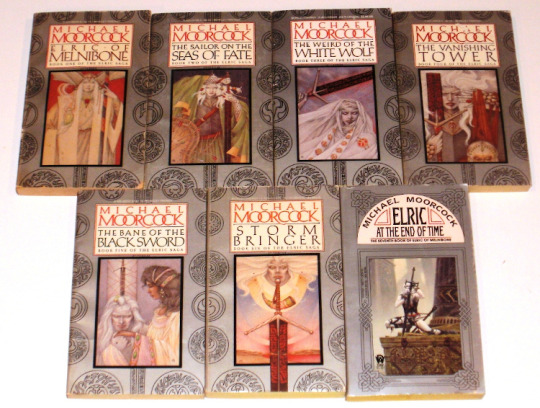
DEADLINE reports on the option of Michael Moorcock’s seminal The Elric Saga.
New Republic Pictures’ Brian Oliver and producer Bradley J. Fischer acquired the exclusive rights to all works in Michael Moorcock’s seminal fantasy-horror series The Elric Saga. They are beginning to shop the property for series, with Glen Mazzara (The Walking Dead and The Shield) and Prison Break and Star Trek: Discovery‘s Vaun Wilmott attached to adapt the sci-fi fantasy tale.
CURIOUS FICTIONS publishes Jaymee Goh’s “A Name to Ashes.”
My father died when I was very small, and my mother could not afford
to take care of us all, so she gave me to the local temple to raise. The
priests were very gracious about it, and appreciated one more pair of
hands to help keep everything tidy. They taught me to read that I may
answer the petitions of the people who came to our temple, taught me to
cook for the beggars that sought succor, taught me to chant the sutras
that would calm souls both dead and living. To read and write was more
than what my brothers could do. Only our eldest brother, Kheng, had had
such an education.Still, I was very close to my brothers, and my mother also, and they
visited me at the temple often. It was very inappropriate, according to
the neighbours, but the priests didn’t seem to mind. We were a happy
family, except for one sadness: the unknown fate of Kheng. He
disappeared a little after I was born, so I have no memories of him. The
last letter he sent said he was boarding a ship to a place called Cuba,
to work there as a clerk. My mother refused to believe he was dead, so
he did not have a tablet on our small family shrine.
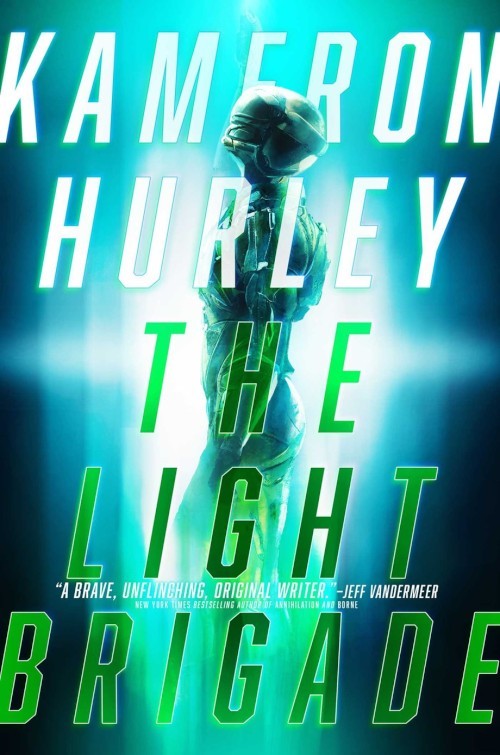
PUBLISHERS WEEKLY names Kameron Hurley’s The Light Brigade as one of the best books of the year.
Hurley’s tale of endless war on Mars is as insightful as it is brutal.
Employing a structurally sophisticated time loop, Hurley captures her
heroine’s growing disillusionment and drives home the horrors of war.
This ambitious work of military science fiction is smart, grisly, and
gripping.
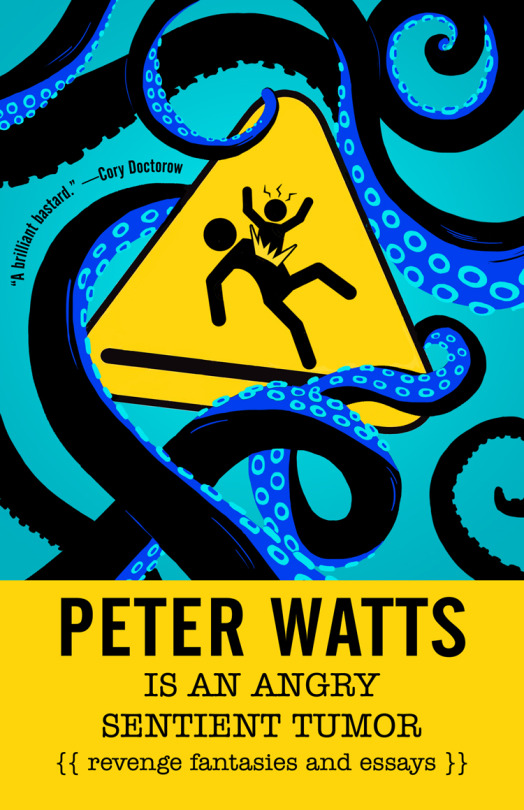
PETER WATTS IS AN ANGRY SENTIENT TUMOR preview: “The Least Unlucky Bastard”
In celebration for the release of the irreverent, self-depreciating, profane, and funny PETER WATTS IS AN ANGRY SENTIENT TUMOR, Tachyon presents glimpses from the essay collection.
The Least Unlucky Bastard
by
Peter Watts

The Daily, May 22 2016
The
doctors say it lives on your skin, waiting for an opening. They say
once it gets inside, your fate comes down to a dice roll. It doesn’t
always turn your guts to slurry; sometimes you get off with a sore
throat, sometimes it doesn’t do anything at all. They might even
admit that it doesn’t always need an open wound. People have been
known to sicken and die from a bruise, from a bump against the door.
What
they won’t generally tell you is that you can get it by
following doctor’s orders. Which is how I ended up in ICU, staring
through a morphine haze into a face whose concerned expression must
have been at least 57% fear of litigation. I didn’t get
flesh-eating disease from a door or a zip-line. I got it from a
dual-punch biopsy—which is to say, from being stabbed with a pair
of needles the size of narwhal tusks. There was this lesion on my
leg, you see. They needed a closer look. And there was Mr. Strep,
waiting on my skin for new frontiers to conquer.
Reality
comes with disclaimers. You’re never sure in hindsight what
actually happened, what didn’t, what composite remnants your brain
might have stitched together for dramatic purposes. I remember waking
embedded in gelatin, in an OR lined with egg cartons; I’m pretty
sure that was a hallucination. I remember my brother’s voice on a
cell-phone between operations, mocking my position on Global Warming.
(That might sound like a hallucination too, but only if you didn’t
know my brother.) I’m pretty sure the ICU nurse was real, the one
who stood bedside as I lay dying and said “You’re an author? I’m
working on a book myself, you know; maybe if you happen to pull
through …”
At
least one memory is fact beyond doubt. My partner Caitlin confirmed
it; the surgeon repeated it; even now I turn it over daily in my head
like some kind of black-hearted anti-affirmation: “Two more hours
and you’d be dead.”
Two
hours? I was in the waiting room longer than that.
It
was fourteen hours from Of course it hurts they just punched two
holes in your leg to shakes and vomiting and self-recrimination:
Come on, you’re a big tough field biologist. Back on Snake
Island you cut a sebaceous cyst out of your own scrotum with a rusty
razor blade and a bottle of rubbing alcohol. I remember drifting
away to the thought that this was just some nasty 24-hour thing, that
I was bound to feel better in the morning. Caitlin kept me awake; she
kept me alive. Together we improvised a sling out of old jeans so I
could hop to the cab without screaming.
Twelve
hours as a succession of whitecoats said cellulitis and
nothing serious and Wait, was it oozing those black bubbles
an hour ago? I crashed somewhere in there: one moment chatting
bravely with friends and caregivers, the next staring into the light
while nurses slapped my face and strapped an Alien facehugger
across my mouth. I don’t know how many instants passed in the black
space between.
They strip-mined the rot from my leg just past midnight. They had to
go in twice. All told, it was forty hours from First Contact to
Death’s Door; forty-two and you wouldn’t be reading this. I spent
weeks with an Australia-sized crater in my calf, watched muscles
slide like meaty pistons every time we changed the dressings. To a
biologist and science-fiction writer, though, that was cool. I
blogged; I spelunked my leg with sporks and Q-tips, took pictures,
impressed nurses and inspired half of Reddit to lose its lunch.
Eventually they scraped a strip off my thigh with a cheese-grater,
stapled it across the hole, told me not to worry about the
rotten-fish smell wafting from the wound. I’ve got a huge
vagina-shaped scar on my leg but I still have that leg—and
just six months after some vicious microbe turned its insides into
chunky beef stew, I was back to running nine miles.
I
wasn’t lucky. None of we flesh-eaten are lucky. But next to
those who’ve lost arms and legs, lives and loved ones to this
ravenous monster—a scar is nothing. It’s a memento. It’s
free beers courtesy of the easily-impressed.
Not
lucky. But I’ve got to be one of the least unlucky bastards
alive.
For more info about PETER WATTS IS AN ANGRY SENTIENT TUMOR, visit the Tachyon page.
Cover design by Elizabeth Story
Icon by John Coulthart
Happy Birthday to the National Book Award winner Lisa Goldstein
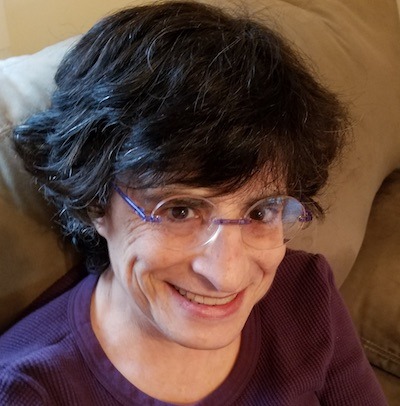
Photo: Doug Asherman
Author of 14 novels, Lisa Goldstein burst upon the literary landscape
after winning the National Book Award for her first novel, The
Red Magician (1982). She followed that tour de force with The
Dream Years (1985),
which garnered her a World Fantasy Award nomination. Goldstein followed those up with a string of acclaimed works including A
Mask for the General (1987;
Arthur C. Clarke nominee),
Tourists (1989;
an
expansion of the lauded short story),
Strange
Devices of the Sun and Moon (1993),
Summer
King, Winter Fool (1994),
Walking
the Labyrinth (1996),
Dark
Cities Underground (1999;
Mythopeic
Fantasy Award nominee),
The
Alchemist’s Door (2002),
THE
UNCERTAIN PLACES (2011;
winner of Mythopeic Fantasy Award), Weighing
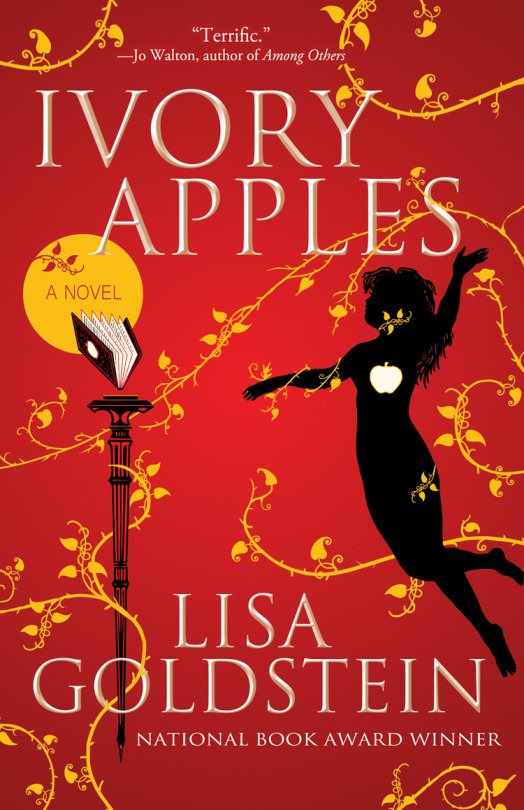
Shadows (2015), and earlier this year IVORY APPLES.
She also penned a pair of novels as Isabel Glass: Daughter
of Exile (2004)
and The
Divided Crown (2005).
Goldstein’s
many respected short stories have been collected in Daily
Voices (1989)
and
Travellers
in Magic (1994).
Her story “Paradise Is a Walled Garden” won the 2011 Sidewise
Award.

All of us at Tachyon wish the amazing Lisa a very special birthday. May the magic never end.
For info on IVORY APPLES, visit the Tachyon page.
Cover by Elizabeth Story
For more info on THE UNCERTAIN PLACES, visit the Tachyon page.
Cover by Ann Monn
PETER WATTS IS AN ANGRY SENTIENT TUMOR preview: “No Brainer”
In celebration for the release of the irreverent, self-depreciating, profane, and funny PETER WATTS IS AN ANGRY SENTIENT TUMOR, Tachyon presents glimpses from the essay collection.
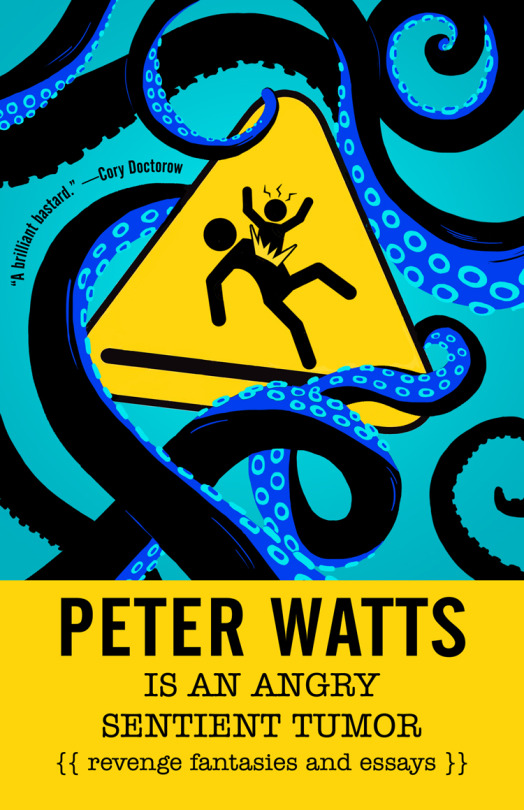
No Brainer
by
Peter Watts

Nowa Fantastyka May 2015
Blog Jul 28 2015
For
decades now, I have been haunted by the grainy, black-and-white x-ray
of a human skull.
It
is alive but empty, with a cavernous fluid-filled space where the
brain should be. A thin layer of brain tissue lines that cavity like
an amniotic sac. The image hails from a 1980 review
article in Science: Roger Lewin, the author, reports that
the patient in question had “virtually no brain”i.
But that’s not what scared me; hydrocephalus is nothing new, and it
takes more to creep out this ex-biologist than a picture of
Ventricles Gone Wild.
What
scared me was the fact that this virtually brain-free patient had an
IQ of 126.
He
had a first-class honors degree in mathematics. He presented normally
along all social and cognitive axes. He didn’t even realize there
was anything wrong with him until he went to the doctor for some
unrelated malady, only to be referred to a specialist because his
head seemed a bit too large.
It
happens occasionally. Someone grows up to become a construction
worker or a schoolteacher, before learning that they should have been
a rutabaga instead. Lewin’s paper reports that one out of ten
hydrocephalus cases are so extreme that cerebrospinal fluid fills 95%
of the cranium. Anyone whose brain fits into the remaining 5% should
be nothing short of vegetative; yet apparently, fully half have IQs
over 100. (Why, here’s another
example from 2007ii;
and yet another.iii)
Let’s call them VNBs, or “Virtual No-Brainers.”
The
paper is titled “Is Your Brain Really Necessary?”, and it seems
to contradict pretty much everything we think we know about
neurobiology.
This Forsdyke guy over in Biological Theory argues
that such cases open the possibility that the brain might utilize
some kind of extracorporeal storageiv,
which sounds awfully woo both to me and to the anonymous
neuroskeptic over at Discovery.comv;
but even Neuroskeptic, while dismissing Forsdyke’s wilder
speculations, doesn’t really argue with the neurological facts on
the ground. (I myself haven’t yet had a chance to more than glance
at the Forsdyke paper, which might warrant its own post if it turns
out to be sufficiently substantive. If not, I’ll probably just
pretend it is and incorporate it into Omniscience.)
On a
somewhat less peer-reviewed note, VNBs also get routinely trotted out
by religious nut jobs who cite them as evidence that a God-given soul
must be doing all those things the uppity scientists keep attributing
to the brain. Every now and then I see them linking to an off-hand
reference I made way back in 2007 (apparently rifters.com is the
only place to find Lewin’s paper online without having to pay a
wall) and I roll my eyes.
And
yet, 126 IQ. Virtually no brain. In my darkest moments of doubt, I
wondered if they might be right.
So
on and off for the past twenty years, I’ve lain awake at night
wondering how a brain the size of a poodle’s could kick my ass at
advanced mathematics. I’ve wondered if these miracle freaks might
actually have the same brain mass as the rest of us, but
squeezed into a smaller, high-density volume by the pressure of all
that cerebrospinal fluid (apparently the answer is: no). While I was
writing Blindsight—having learned that cortical modules in
the brains of autistic savants are relatively underconnected, forcing
each to become more efficient—I wondered if some kind of
network-isolation effect might be in play.
Now,
it turns out the answer to that is: Maybe.
Three
decades after Lewin’s paper, we have “Revisiting
hydrocephalus as a model to study brain resilience” by de
Oliveira et alvi
(actually published in 2012, although I didn’t read it until last
spring). It’s a “Mini Review Article”: only four pages, no new
methodologies or original findings—just a bit of background, a
hypothesis, a brief “Discussion” and a conclusion calling for
further research. In fact, it’s not so much a review as a challenge
to the neuro community to get off its ass and study this fascinating
phenomenon—so that soon, hopefully, there’ll be enough new
research out there warrant a real review.
The
authors advocate research into “Computational models such as the
small-world
and scale-free
network”—networks whose nodes are clustered into
highly-interconnected “cliques”, while the cliques themselves are
more sparsely connected one to another. De Oliveira et al
suggest that they hold the secret to the resilience of the
hydrocephalic brain. Such networks result in “higher dynamical
complexity, lower wiring costs, and resilience to tissue insults.”
This also seems reminiscent of those isolated hyper-efficient modules
of autistic savants, which is unlikely to be a coincidence: networks
from social to genetic to neural have all been described as
“small-world.” (You might wonder—as I did—why de Oliveira et
al. would credit such networks for the normal intelligence of
some hydrocephalics when the same configuration is presumably
ubiquitous in vegetative and normal brains as well. I can only assume
they meant to suggest that small-world networking is especially
well-developed among high-functioning hydrocephalics.) (In all
honesty, it’s not the best-written paper I’ve ever read.)
The
point, though, is that under the right conditions, brain damage
may paradoxically result in brain enhancement. Small-world,
scale-free networking—focused, intensified, overclocked—might
turbocharge a fragment of a brain into acting like the whole thing.
Can
you imagine what would happen if we applied that trick to a normal
brain?
If
you’ve read Echopraxia, you’ll remember the Bicameral
Order: the way they used tailored cancer genes to build extra
connections in their brains, the way they linked whole brains
together into a hive mind that could rewrite the laws of physics in
an afternoon. It was mostly bullshit, of course: neurological
speculation, stretched eight unpredictable decades into the future
for the sake of a story.
But
maybe the reality is simpler than the fiction. Maybe you don’t have
to tweak genes or interface brains with computers to make the next
great leap in cognitive evolution. Right now, right here in the real
world, the cognitive function of brain tissue can be boosted—without
engineering, without augmentation—by literal orders of magnitude.
All it takes, apparently, is the right kind of stress. And if the
neuroscience community heeds de Oliveira et al’s clarion
call, we may soon know how to apply that stress to order. The
singularity might be a lot closer than we think.
Also
a lot squishier.
Wouldn’t
it be awesome if things turned out to be that easy?
i
http://rifters.com/real/articles/Science_No-Brain.pdf
ii
https://doi.org/10.1016/S0140-6736(07)61127-1
iii
http://mymultiplesclerosis.co.uk/ep/sharon-parker-the-woman-with-the-mysterious-brain/
iv
http://rifters.com/real/articles/Forsdyke-2015-BrainScansofHydrocephalicsChallengeCherishedAssumptions.pdf
v
http://blogs.discovermagazine.com/neuroskeptic/2015/07/26/is-your-brain-really-necessary-revisited/
vi
http://rifters.com/real/articles/Oliveira-et-al-2012-RevisitingHydrocephalus.pdf
For more info about PETER WATTS IS AN ANGRY SENTIENT TUMOR, visit the Tachyon page.
Cover design by Elizabeth Story
Icon by John Coulthart
oh nothing much, just some robots hanging out, being friends
#books #bookstagram #scifibooks #sciencefictionbooks #anthology #shortstories #robot #scifi #sciencefiction #steampunk #steampunkbook #thenewvoicesofsciencefiction #invaders #bookpile #publishing #tachyon #tachyonpublications #jacobweisman #annvandermeer #hannurajaniemi
https://www.instagram.com/p/B5GQqlqgNG6/?igshid=5cn6frvd3onj
THE NEW VOICES OF SCIENCE FICTION is a must-read anthology for anyone who loves the genre
The praise and excitement for Hannu Rajaniemi and Jacob Weisman‘s recently released THE NEW VOICES OF SCIENCE FICTION keeps rolling in…
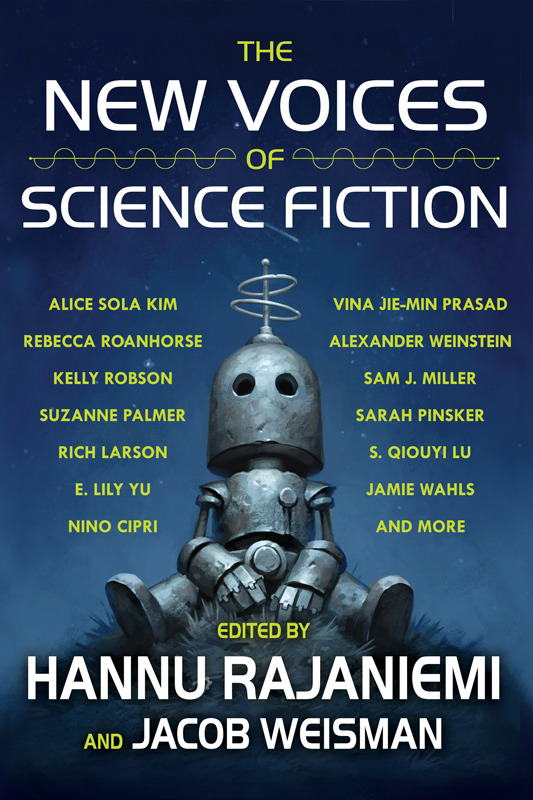
…especially at B&N SCI-FI & FANTASY BLOG, first with inclusions in 25 Otherworldly Science Fiction & Fantasy Books Arriving in November and This Week’s New Sci-Fi & Fantasy Books, and finally culminating in an extensive review from Maria Haskins.
Enriched by its ranged and buoyed by the remarkable talents of its contributors, THE NEW VOICES OF SCIENCE FICTION is
a must-read anthology for anyone who loves the genre, demonstrating
vividly just how vital it remains. As Rajaniemi’s foreward suggests:
“Read them, and be changed.”
Jacob A. Olson of REALMS & ROBOTS concurs.
Each of these stories provide a prime example of strong writing and
character work, sending you throughout space and time to discover
compelling futures.
For AMAZING STORIES, Ernest Lively recommends the book.
Here’s the chance to catch up and get to know a collection of authors we’ll certainly be hearing more from.
John O’Neill at BLACK GATE delivers similar sentiments.
This looks like one of the major anthologies of the fall, and it has vaulted near the top of my TBR pile.
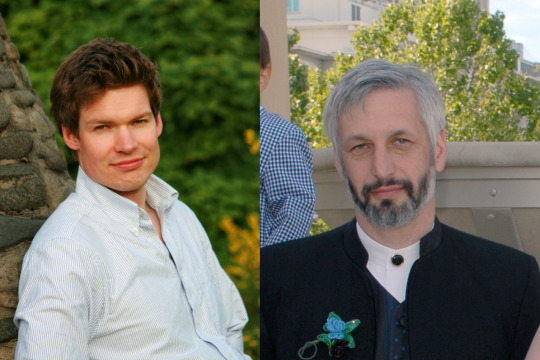
Hannu Rajaniemi and Jacob Weisman
Paul Semel interviews the editors about the anthology.
To begin, what is THE NEW VOICES OF SCIENCE FICTION? I know it’s a short story collection, but what is the commonality between these stories?
Jacob: THE NEW VOICES OF SCIENCE FICTION
highlights stories by new writers, writers who have begun publishing in
the last 10 years. The least recent stories in the collection were
published in 2015. The newest, E. Lily Yu’s “The Doing And Undoing Of
Jacob E. Mwangi,” was published earlier this year in Asimov’s SF. We bought Lily’s story before it appeared in print.
Why did you think this would be a good basis for a collection
of science fiction short stories, and why did you also think this was
something you each wanted to edit?
Jacob: It’s hard not to be interested in
the various directions science fiction may be headed, the future of the
future. I’ve been reading more and more stories recently by newer
writers and this was an opportunity for me to delve deeper.Hannu: I was also intrigued by the notion of a
writer’s voice, what it means to be a new voice, and what new voices
have in common. And then of course there were all these sparkling,
wonderful stories out there that had that temporal newness but also
tonal freshness in common: they deserved a home.
For more info about THE NEW VOICES OF SCIENCE FICTION, visit the Tachyon page.
Cover art by Matt Dixon
Cover design by Elizabeth Story